


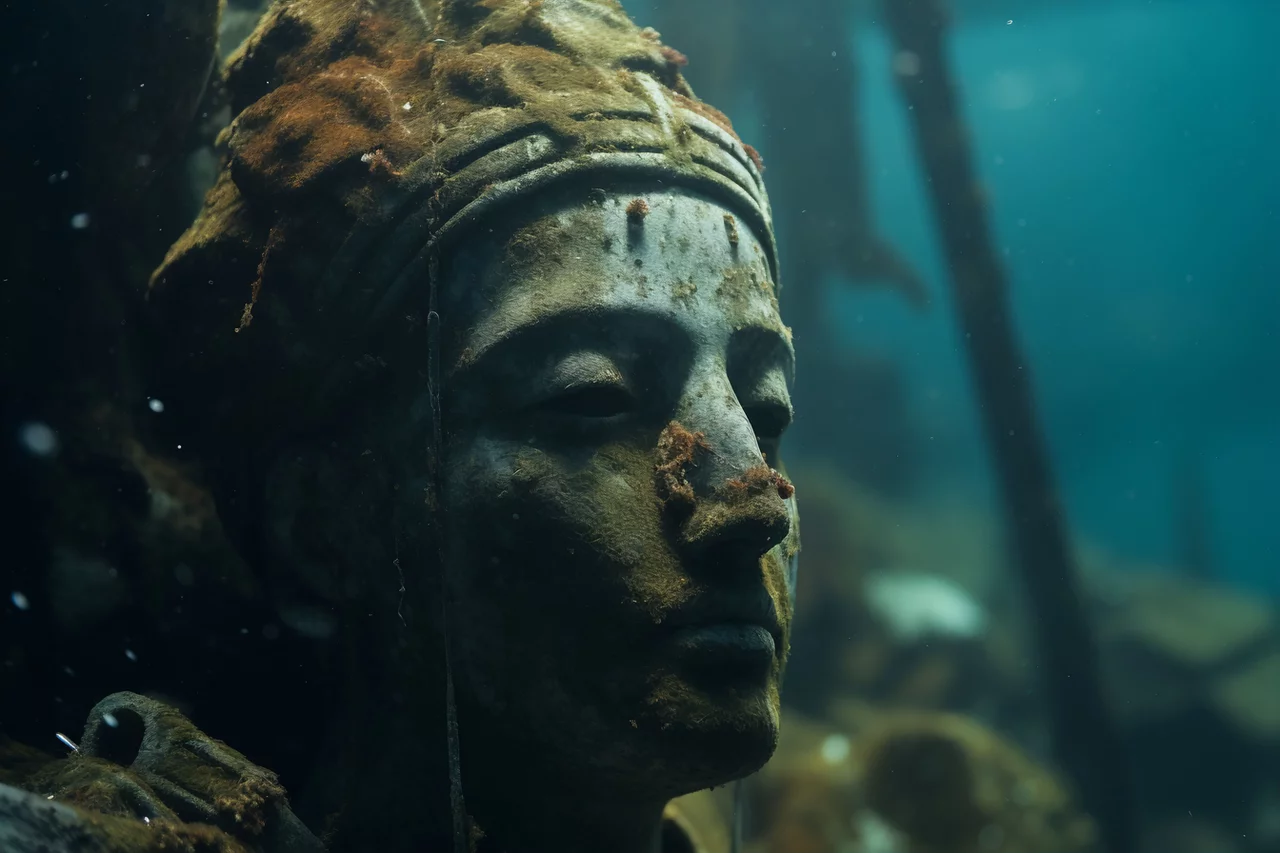
What if we told you that entire cities lie hidden beneath the waters of our planet? Let’s discover them together.
The ocean hides more secrets than we can imagine. Places once full of life now rest silently under oceans, lakes, and seas. Ancient metropolises swallowed by the sea or forgotten enclaves under fresh waters, these sunken cities remind us of the fragility of civilization.
Some of these cities were destroyed by earthquakes and tsunamis, others disappeared over time, and some still spark theories and legends. In this underwater journey, we’ll explore 10 cities that, though submerged, continue to tell the stories of the past.
1. Pavlopetri (Greece) – The oldest city under the sea
Located on the coast of Laconia, Pavlopetri is one of the oldest sunken cities in the world, more than 5,000 years old. Discovered in 1967, it still preserves its urban planning with streets, houses, and tombs. Its sinking is attributed to earthquakes and changes in sea level.
2. Heracleion (Egypt) – The Egyptian Atlantis
This city, also known as Thonis, was the most important port of ancient Egypt before Alexandria. It sank between the 3rd and 2nd centuries BC, and its ruins were rediscovered in the year 2000. In its waters rest temples, giant statues, and treasures that reveal its lost splendor. One of the most fascinating sunken cities in the world.
3. Port Royal (Jamaica) – The pirate city swallowed by the sea
Known as the “Sodom of the New World,” this pirate settlement was destroyed by an earthquake and tsunami in 1692. Today, its remains lie underwater and attract archaeologists and divers in search of stories of corsairs and lost treasures.
4. Atlit-Yam (Israel) – A Neolithic village under the Mediterranean
Discovered on the coast of Israel, this prehistoric village is 9,000 years old and was submerged by rising sea levels. The most striking feature is its ritual stone circle, similar to an underwater Stonehenge.
5. The city in the Gulf of Khambhat (India) – Mystery under the water
Located on the coast of Gujarat, this sunken city may have existed between 7,545 and 7,490 BC. It is believed to have been Dvaraka, the sacred Hindu city founded by Krishna, although this is still debated.
Don’t forget to bring some cash when visiting these places because, even though the use of cards in accommodations and shops may be widespread, there will be locations where you can only use cash.
he most convenient and simple way to get the currency of the country you are traveling to is through home delivery from Ria or at any of its offices (more than 500,000 branches in over 190 countries). One of the best exchange rates and without the need to leave your home or exchange money in “strange places.”
6. Sunken Alexandria (Egypt) – The ancient Egyptian capital hidden in the sea
Around modern Alexandria lie the remains of what may have been its original port. Due to earthquakes and soil liquefaction, parts of this city sank, including temples and statues of pharaohs.
7. Baiae (Italy) – “The Las Vegas” of the Roman Empire
Located in the Bay of Naples, Baiae was a luxury city for the Roman aristocracy. Due to volcanic activity, much of it sank. Today, its ruins form an impressive underwater archaeological park and it is one of the most attractive sunken cities in the world.
8. The Temple of Lake Titicaca (Bolivia) – Ruins of a pre-Inca civilization
In 2000, explorers discovered the remains of a temple at the bottom of Lake Titicaca that may have belonged to the Tiahuanaco civilization, predecessor of the Incas. Its ruins could change our understanding of Andean cultures.
9. Shi Cheng (China) – The Chinese Atlantis
Shi Cheng was a Ming Dynasty city that was submerged in 1959 due to the construction of a dam. Unlike other lost cities, this one was deliberately submerged and today it is a fascinating destination for diving. One of the easiest sunken cities to visit.
10. Yonaguni (Japan) – Lost city or natural formation?
Discovered in the 1980s off the coast of Japan, this rock structure has generated debate among archaeologists. Some believe it is the remains of an ancient civilization, while others think it is a natural formation.
Sunken cities are time capsules that remind us how fleeting civilization can be. Sometimes natural disasters, and at other times human impact, have caused these settlements to become trapped under water, waiting for modern archaeology to decipher their secrets. From majestic Heracleion in Egypt to mysterious Yonaguni in Japan, these places continue to fascinate historians, explorers, and curious travelers.
As technology advances, new sunken cities may be discovered in the oceans, revealing even more about the mysteries of the past. Would you like to discover the stories waiting beneath the depths?